The rest of the survey: Walsh mesas, Gaussian isles, dunes, Sudoku mesas, driver walls, and round six's ranges

The last five items from the pytoolz survey built into worlds, the Ruler Alps, Dyadic Isles and Ruler Canyons of round six, and the gate network. Every landscape is in both twins and checked against one fixture; the write-up is LAND_FROM_THE_LIBRARY.md, sections 5 to 9.

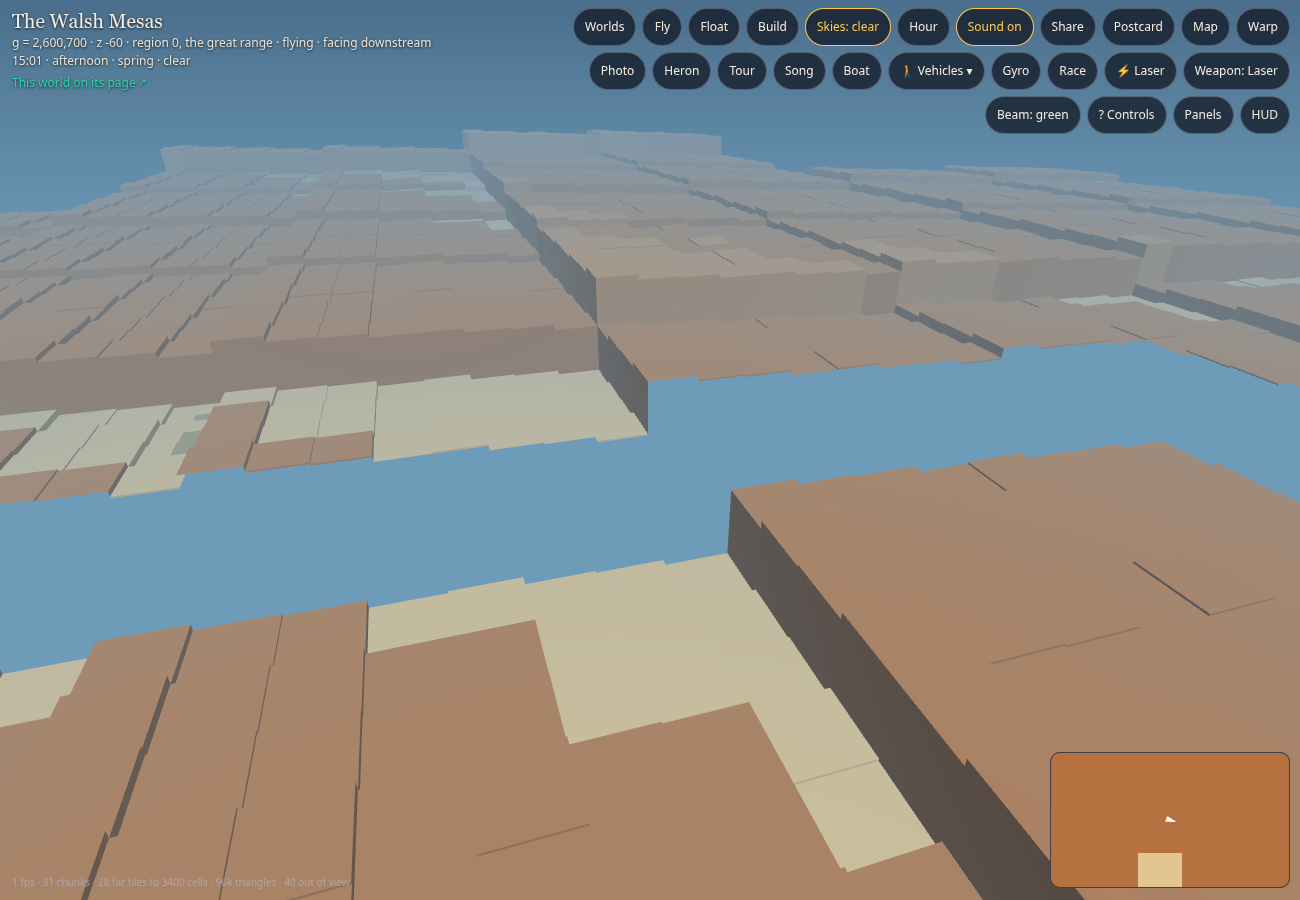
The Walsh Mesas: W(k, t) = (-1)^popcount(k AND t), the exact square waves of integer space, as ground. The single-bit functions W(2^j, x) and W(2^j, z) for j from 4 to 8 are summed, each weighted by the ladder CUM[j], as (2 + W + W)/4: a full mesa where both bits are clear, half a mesa where one is. Every edge is aligned to a power of two and there is no noise anywhere; the water fills the lowest tiles.
▶ Go there sv-1-the-walsh-mesas
The Walsh Mesas: W(k, t) = (-1)^popcount(k AND t), the exact square waves of integer space, as ground. The single-bit functions W(2^j, x) and W(2^j, z) for j from 4 to 8 are summed, each weighted by the ladder CUM[j], as (2 + W + W)/4: a full mesa where both bits are clear, half a mesa where one is. Every edge is aligned to a power of two and there is no noise anywhere; the water fills the lowest tiles.
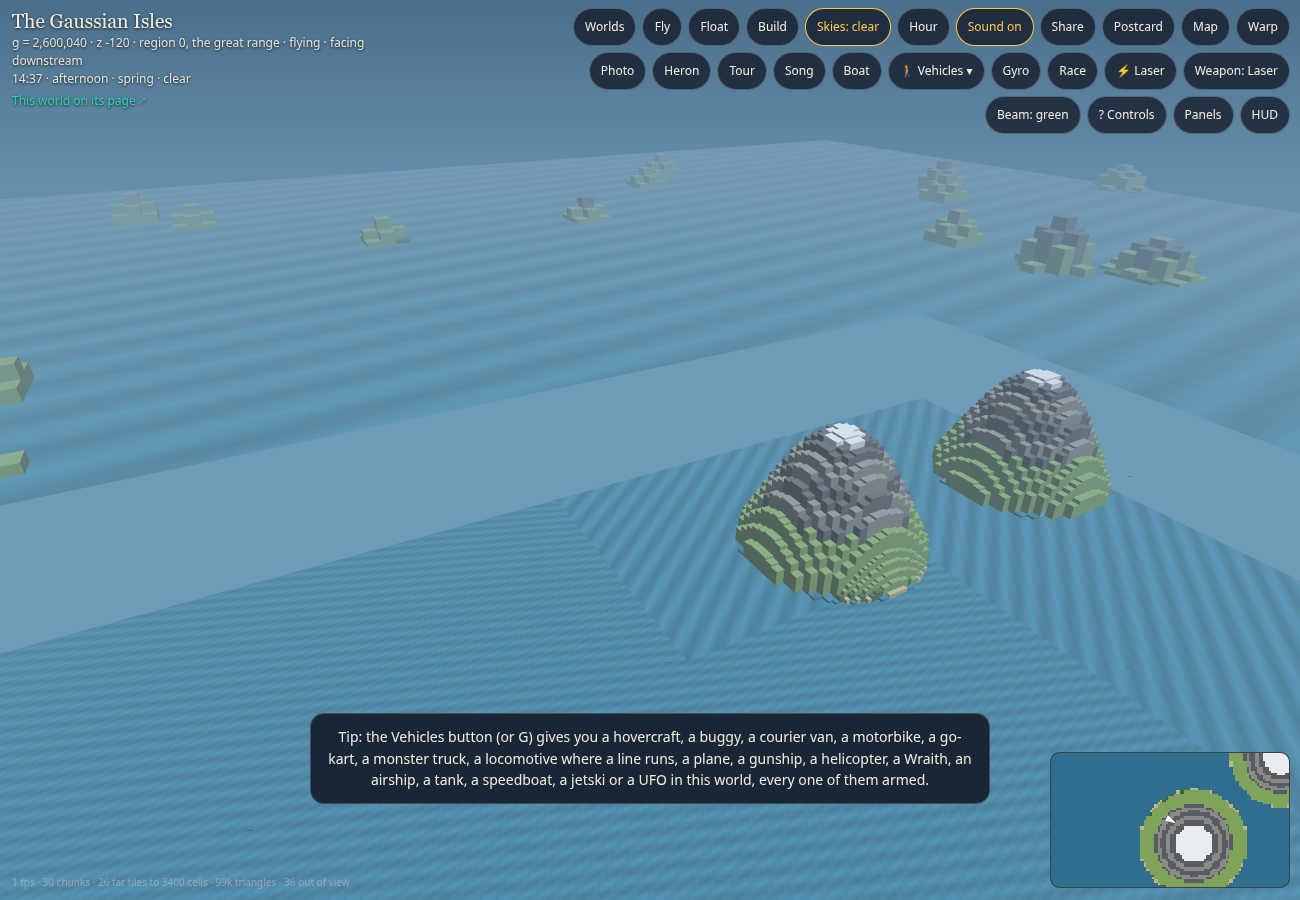
The Gaussian Isles: the sea is cut into 32-cell squares and square (a, b) carries an island exactly when a² + b² is prime, a Gaussian prime off the axes. The prime's residues set the island's radius and height, so no two are alike, and the archipelago thins like 1/ln(a² + b²) with the eightfold symmetry of the Gaussian integers. Primality is trial division, memoised, identical in both twins; the start stands on the island at (81254, -1).
▶ Go there sv-2-the-gaussian-isles
The Gaussian Isles: the sea is cut into 32-cell squares and square (a, b) carries an island exactly when a² + b² is prime, a Gaussian prime off the axes. The prime's residues set the island's radius and height, so no two are alike, and the archipelago thins like 1/ln(a² + b²) with the eightfold symmetry of the Gaussian integers. Primality is trial division, memoised, identical in both twins; the start stands on the island at (81254, -1).
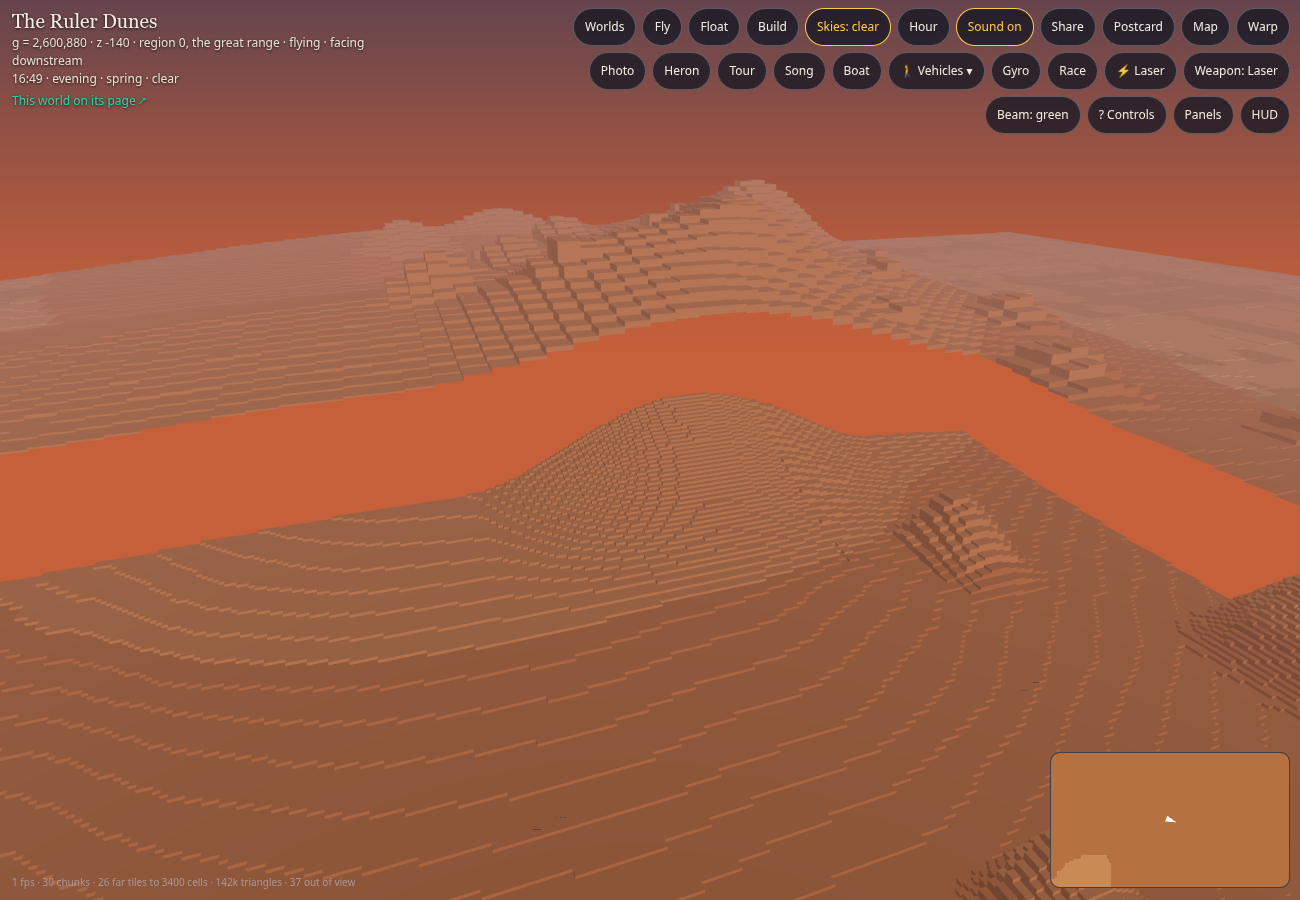
The Ruler Dunes at evening: the hill law drawn with a fluid's profile. fluidz ran the Burgers equation on the integer lattice from a sine to 0.95 of its blow-up time, and the steepened wave, a back slope 205 sites long and a scarp of 51, is sampled 64 times as the cross-section of every hill. Gentle from the west, a cliff to the east, by rank, on the seven lanes.
▶ Go there sv-3-the-ruler-dunes
The Ruler Dunes at evening: the hill law drawn with a fluid's profile. fluidz ran the Burgers equation on the integer lattice from a sine to 0.95 of its blow-up time, and the steepened wave, a back slope 205 sites long and a scarp of 51, is sampled 64 times as the cross-section of every hill. Gentle from the west, a cliff to the east, by rank, on the seven lanes.
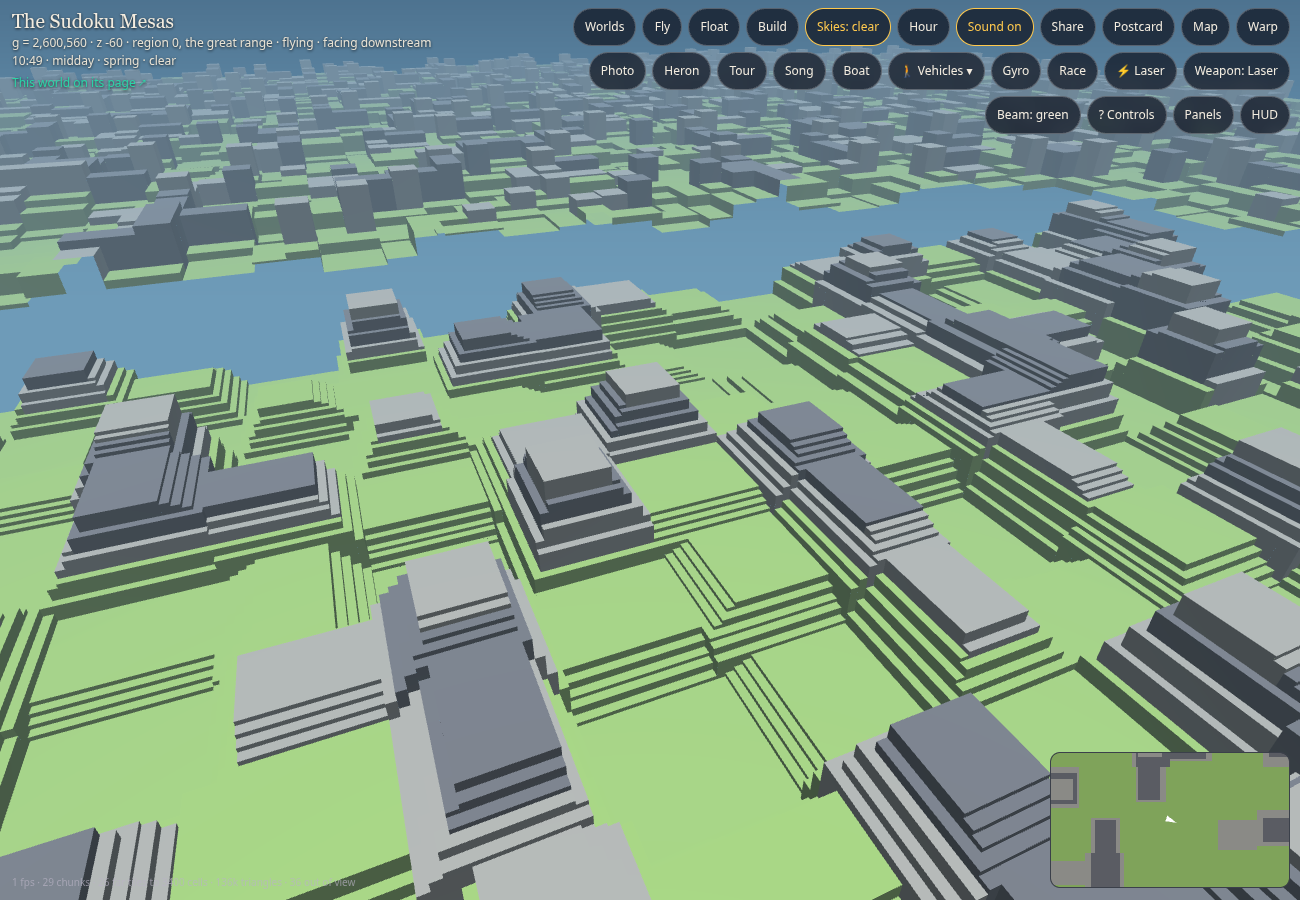
The Sudoku Mesas: four solved grids from Larsdoku as ground. Every 9-by-9 block is a board, every cell a 16-cell mesa standing digit times four blocks high, so no two mesas in a row, a column or a box are level, and the ladder's ramp rule, lifted out as terraces(), runs down every edge. A river of region 0 crosses the boards.
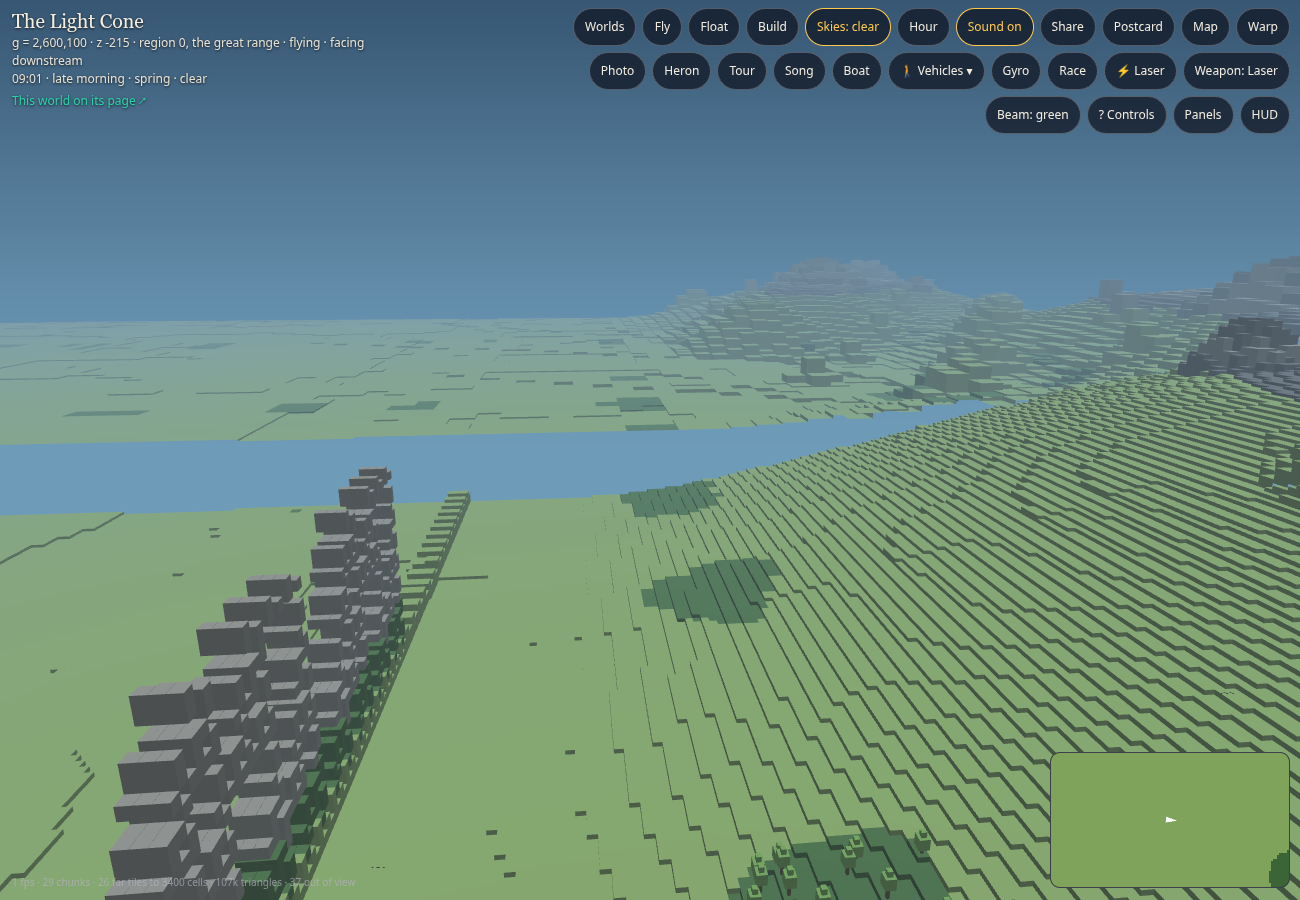
▶ Go there sv-4-the-sudoku-mesas
The Sudoku Mesas: four solved grids from Larsdoku as ground. Every 9-by-9 block is a board, every cell a 16-cell mesa standing digit times four blocks high, so no two mesas in a row, a column or a box are level, and the ladder's ramp rule, lifted out as terraces(), runs down every edge. A river of region 0 crosses the boards.
The Light Cone's north wall under the XOR driver: the same register, x_j ← x_j XOR (x_{j-1} XOR x_{j-2}), whose periods grow only logarithmically (1, 2, 4, 4, 8, 8, 8, 8, ...), so the lace is a Sierpinski staircase that repeats every 64 columns at this generation. The theorem holds for all sixteen drivers: every coordinate is periodic with a power-of-two period.
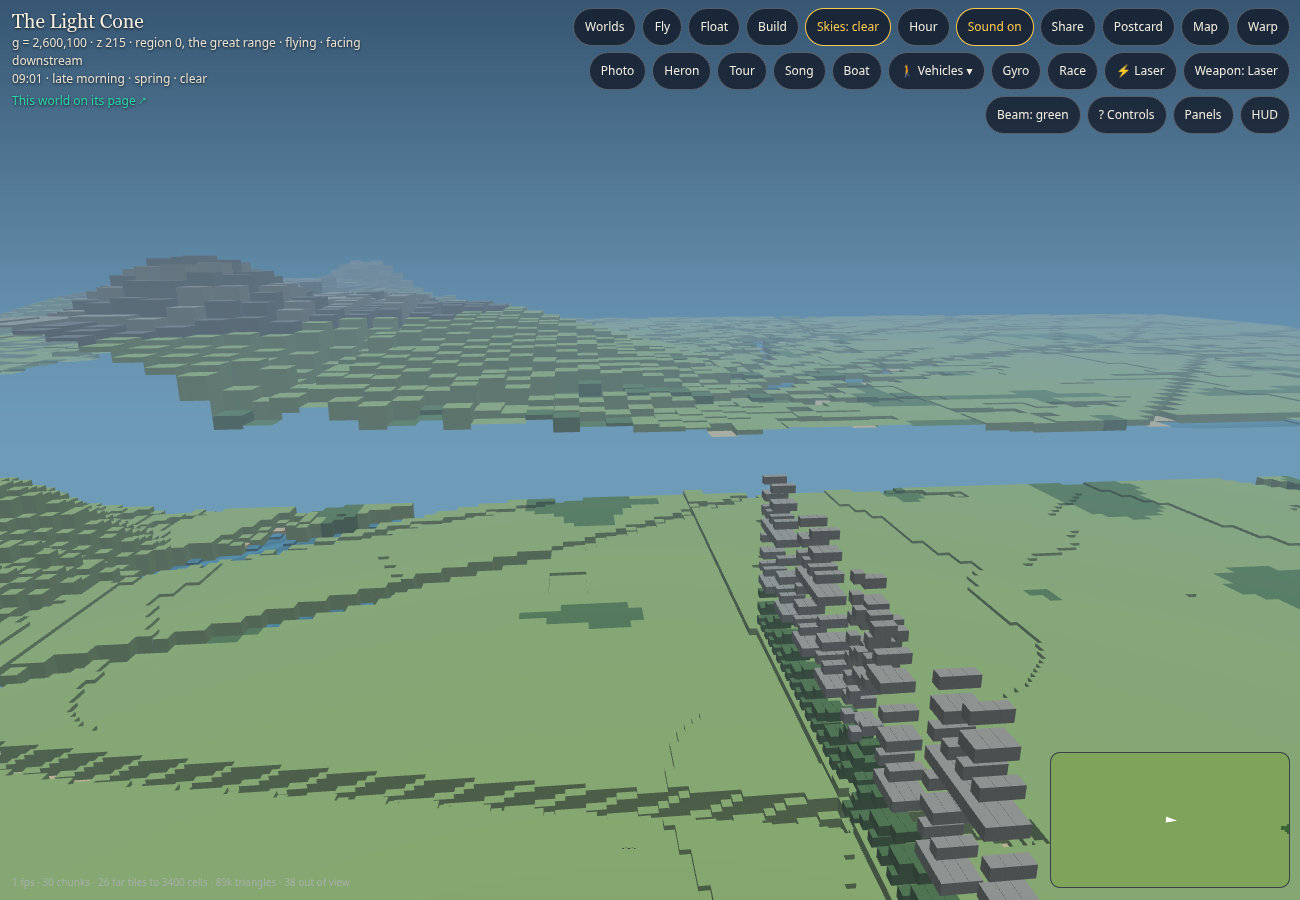
▶ Go there sv-5-the-xor-wall-of-the-light-cone
The Light Cone's north wall under the XOR driver: the same register, x_j ← x_j XOR (x_{j-1} XOR x_{j-2}), whose periods grow only logarithmically (1, 2, 4, 4, 8, 8, 8, 8, ...), so the lace is a Sierpinski staircase that repeats every 64 columns at this generation. The theorem holds for all sixteen drivers: every coordinate is periodic with a power-of-two period.
The south wall under the comb driver, b AND NOT a: every other coordinate is frozen, so the wall is a comb of even rows with periods 1, 2, 4, 4, ... measured from a single-cell seed, in both twins, up to 2^14. Three walls, three drivers, one law.
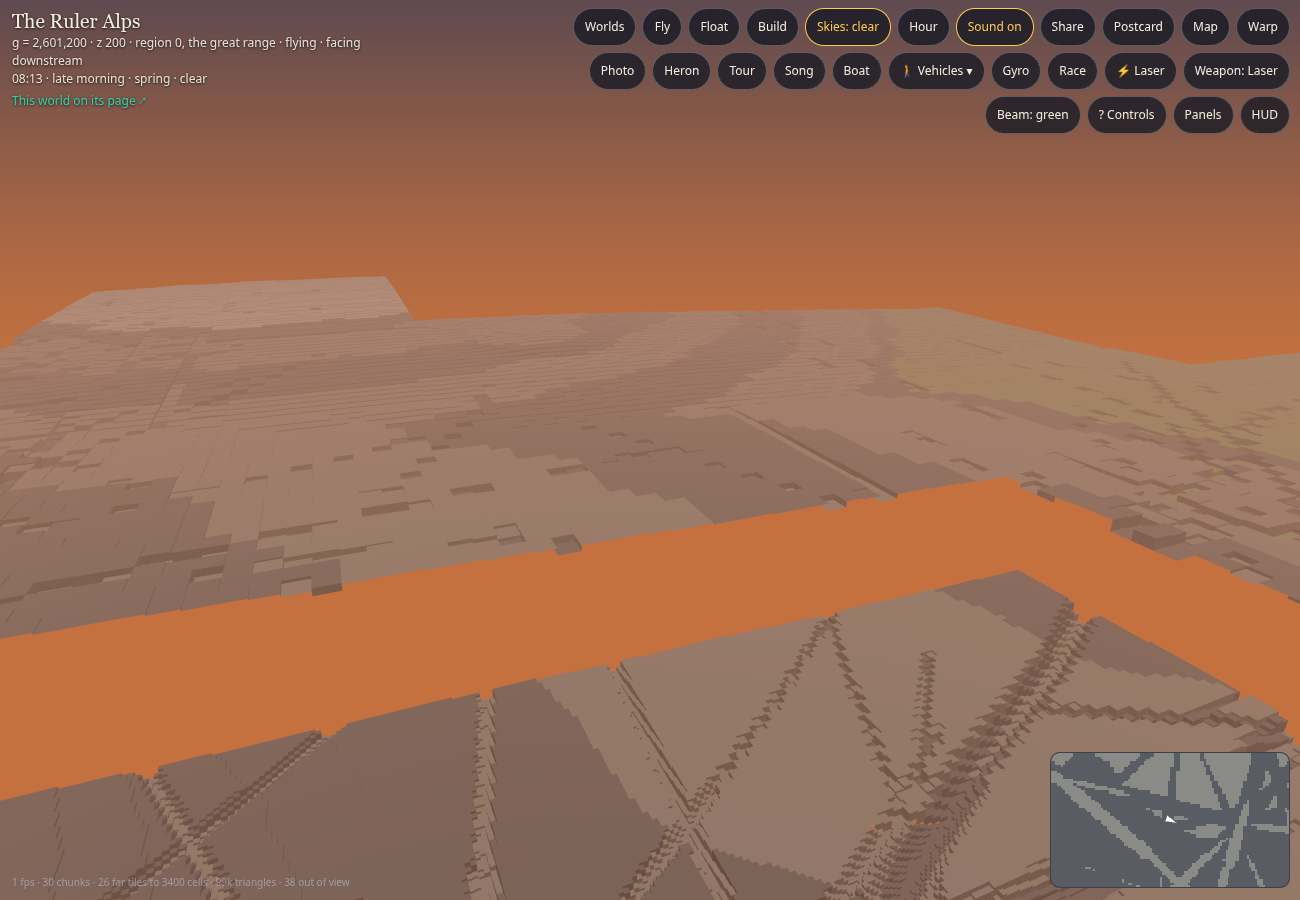
▶ Go there sv-6-the-comb-wall-of-the-light-cone
The south wall under the comb driver, b AND NOT a: every other coordinate is frozen, so the wall is a comb of even rows with periods 1, 2, 4, 4, ... measured from a single-cell seed, in both twins, up to 2^14. Three walls, three drivers, one law.
The Ruler Alps under the max law, morning. Ranks six to eleven at the law's own radius, the tallest hill winning instead of the sum, the relief term sinking the flats, rivers in the cuts; snow above 120.
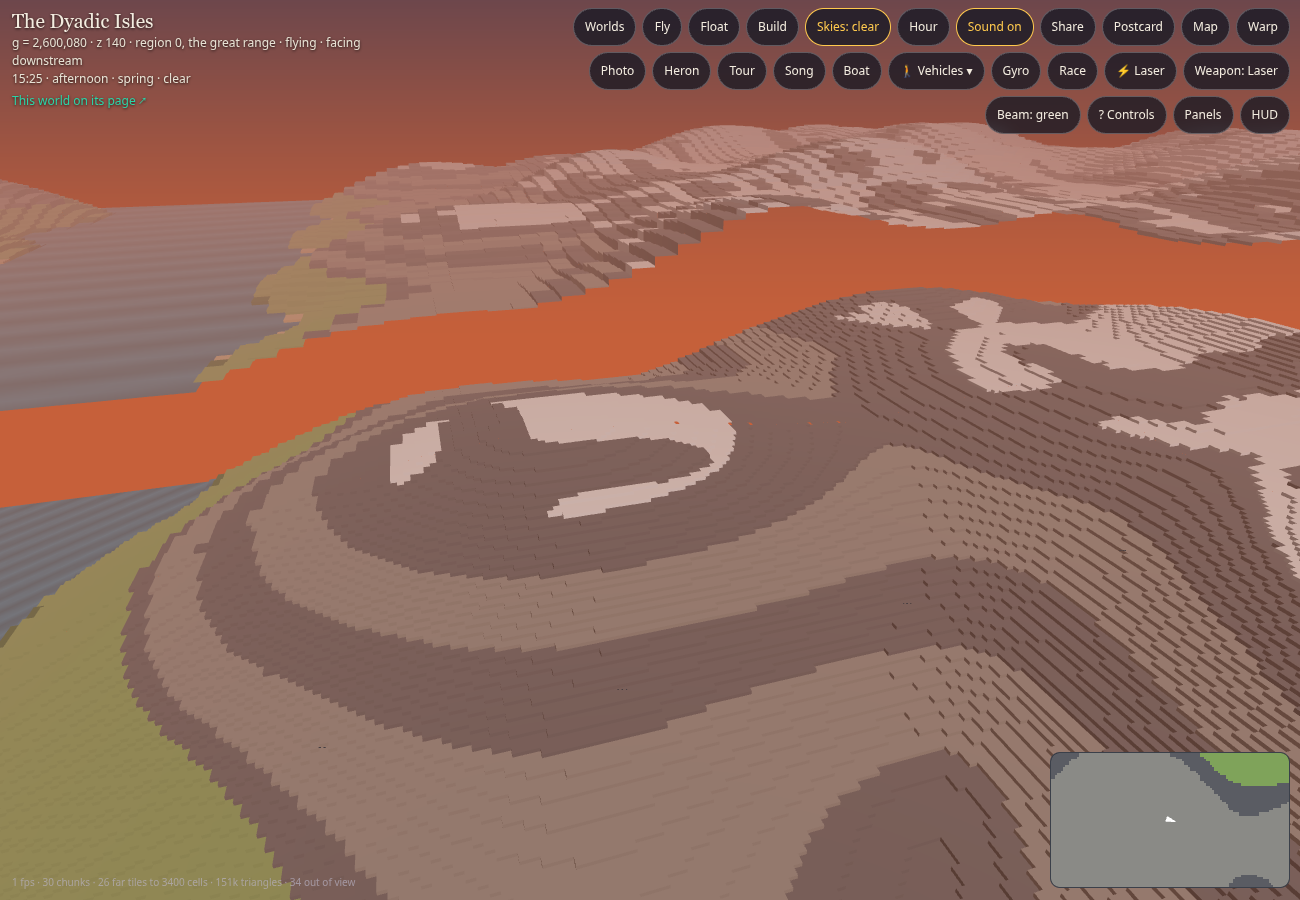
▶ Go there sv-7-the-ruler-alps
The Ruler Alps under the max law, morning. Ranks six to eleven at the law's own radius, the tallest hill winning instead of the sum, the relief term sinking the flats, rivers in the cuts; snow above 120.
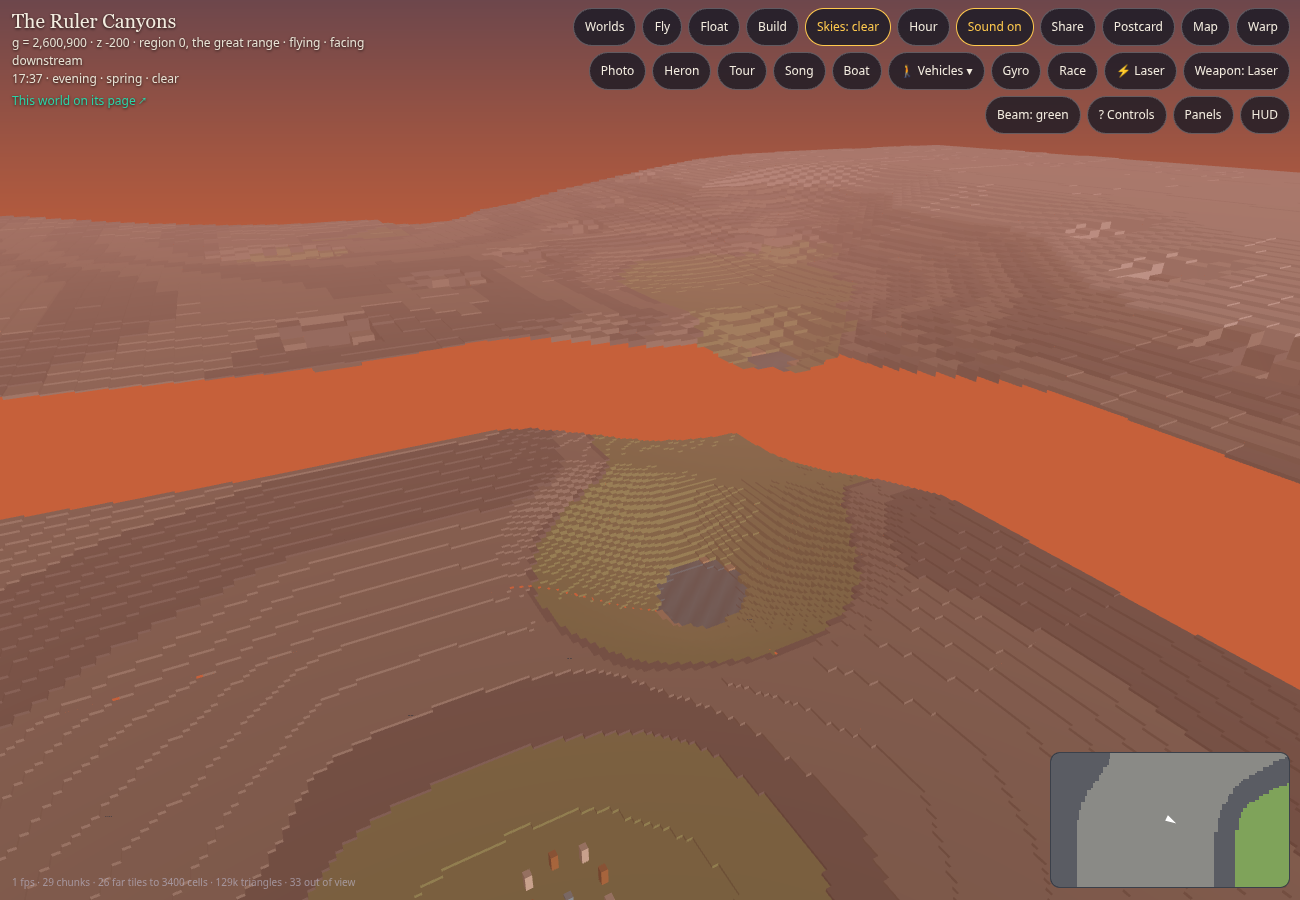
The Dyadic Isles: the Dyadic Downs with the sea let in. The base sits sixteen blocks under the water, so only lattice hills of rank seven and up break the surface, each an island where both coordinates are divisible by 128 or more. The start is on the island at row 127.
▶ Go there sv-8-the-dyadic-isles
The Dyadic Isles: the Dyadic Downs with the sea let in. The base sits sixteen blocks under the water, so only lattice hills of rank seven and up break the surface, each an island where both coordinates are divisible by 128 or more. The start is on the island at row 127.
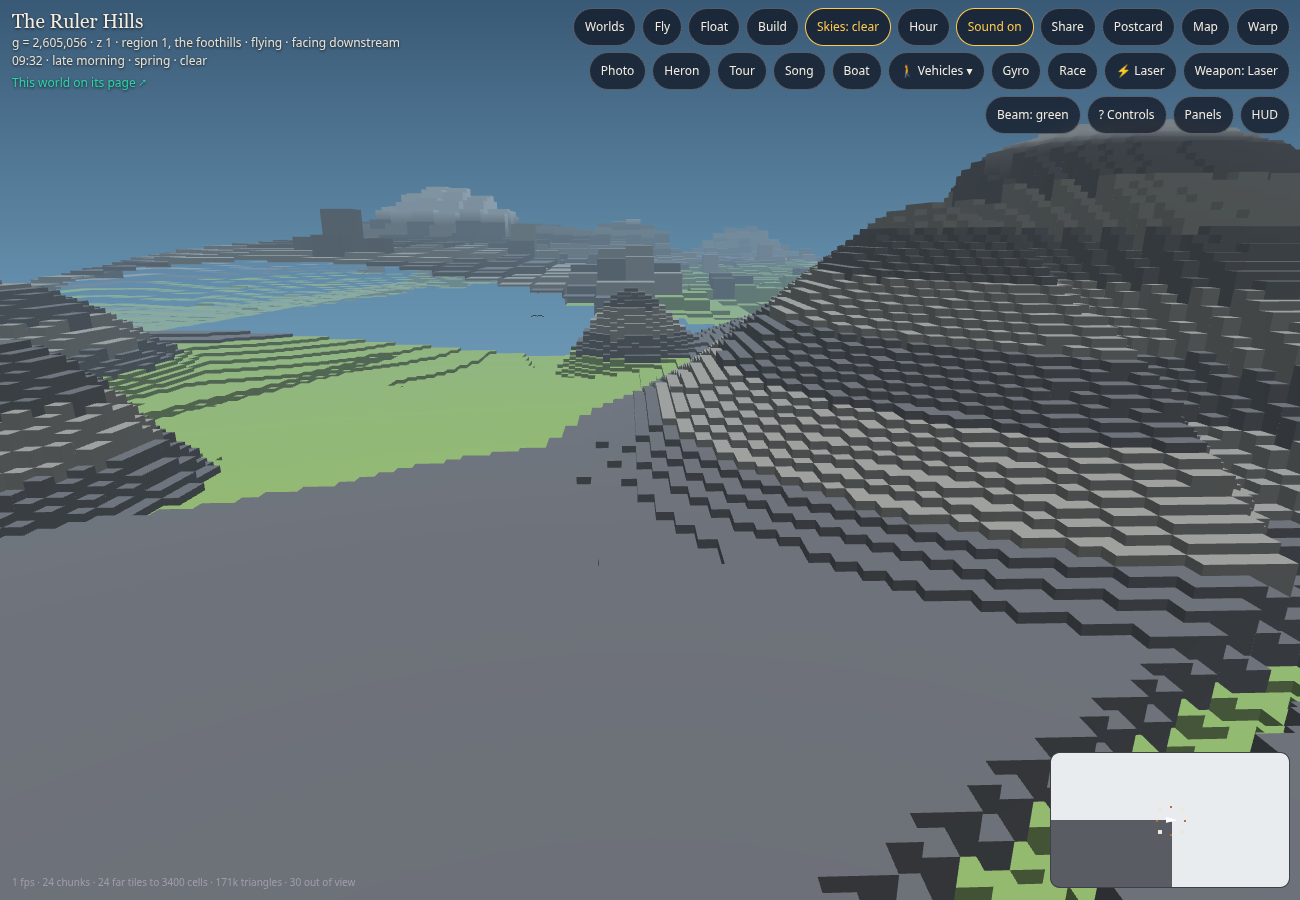
The Ruler Canyons: the hill law turned downward. A plateau 150 blocks high, and every ranked column cuts a canyon into it as deep as its hill would have been tall, so the rank-9 columns go down to the water and fill as lakes. The Tour (G) flies the six deepest cuts; the prizes stand on the canyon floors.
▶ Go there sv-9-the-ruler-canyons
The Ruler Canyons: the hill law turned downward. A plateau 150 blocks high, and every ranked column cuts a canyon into it as deep as its hill would have been tall, so the rank-9 columns go down to the water and fill as lakes. The Tour (G) flies the six deepest cuts; the prizes stand on the canyon floors.
Through the gate network: standing in the glass centre of region 0's gate sent us to region 1's gate, 4,096 columns east, and the toast named its warp address. Every region's gate stands on its biggest hill; step out of the glass and the gate is armed again.
▶ Go there sv-10-through-the-gate-network
Through the gate network: standing in the glass centre of region 0's gate sent us to region 1's gate, 4,096 columns east, and the toast named its warp address. Every region's gate stands on its biggest hill; step out of the glass and the gate is armed again.