The ruler mesh

terrain=mesh: a range's ground as one crack-free mesh on Lars Rocha's ruler, every cell a corner near you and the rings doubling out to the horizon.

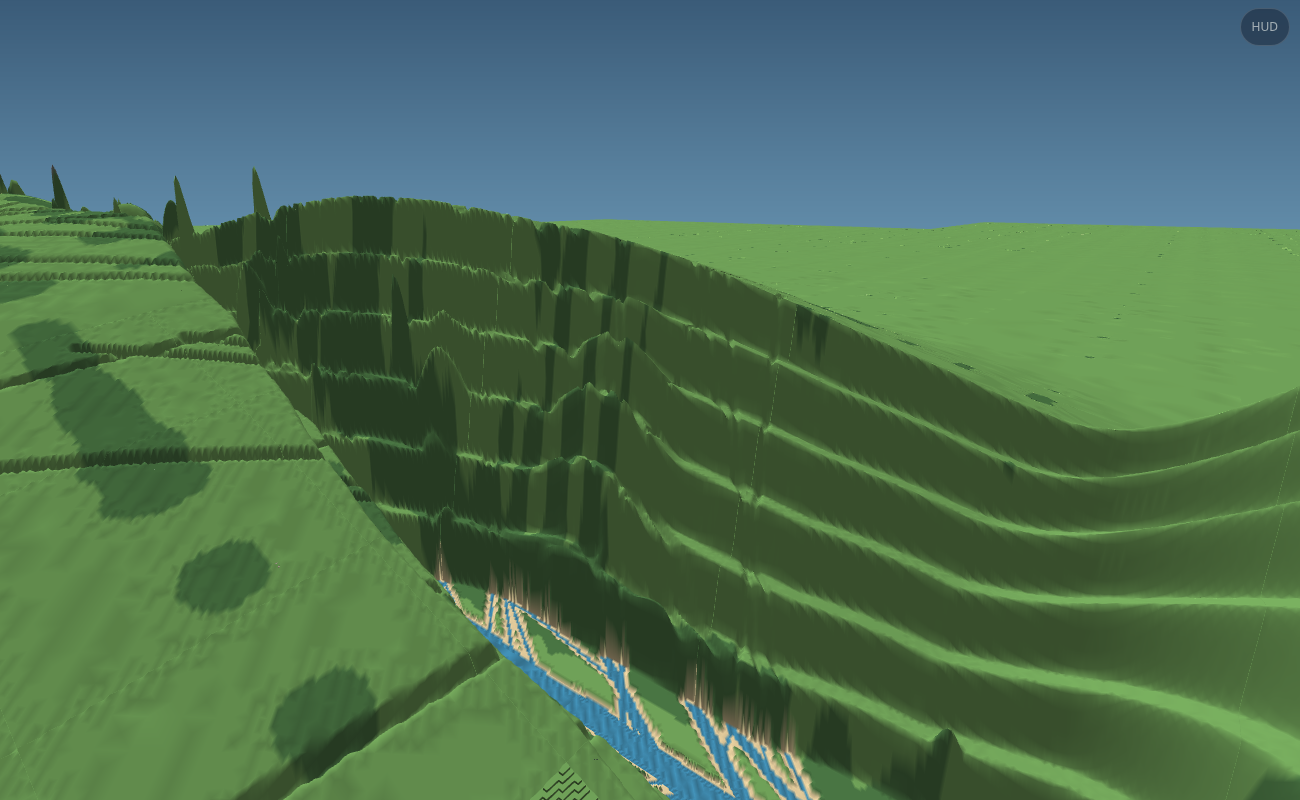
Before: the Ternary Gorge at detail ultra, the smooth far tiles as they were (every sample kept on a ridge, flat ground merged): 235 tiles and 1,904,936 triangles, the 3 x 3 voxel chunks under the camera.
▶ Go there mesh-1-gorge-ultra
Before: the Ternary Gorge at detail ultra, the smooth far tiles as they were (every sample kept on a ridge, flat ground merged): 235 tiles and 1,904,936 triangles, the 3 x 3 voxel chunks under the camera.
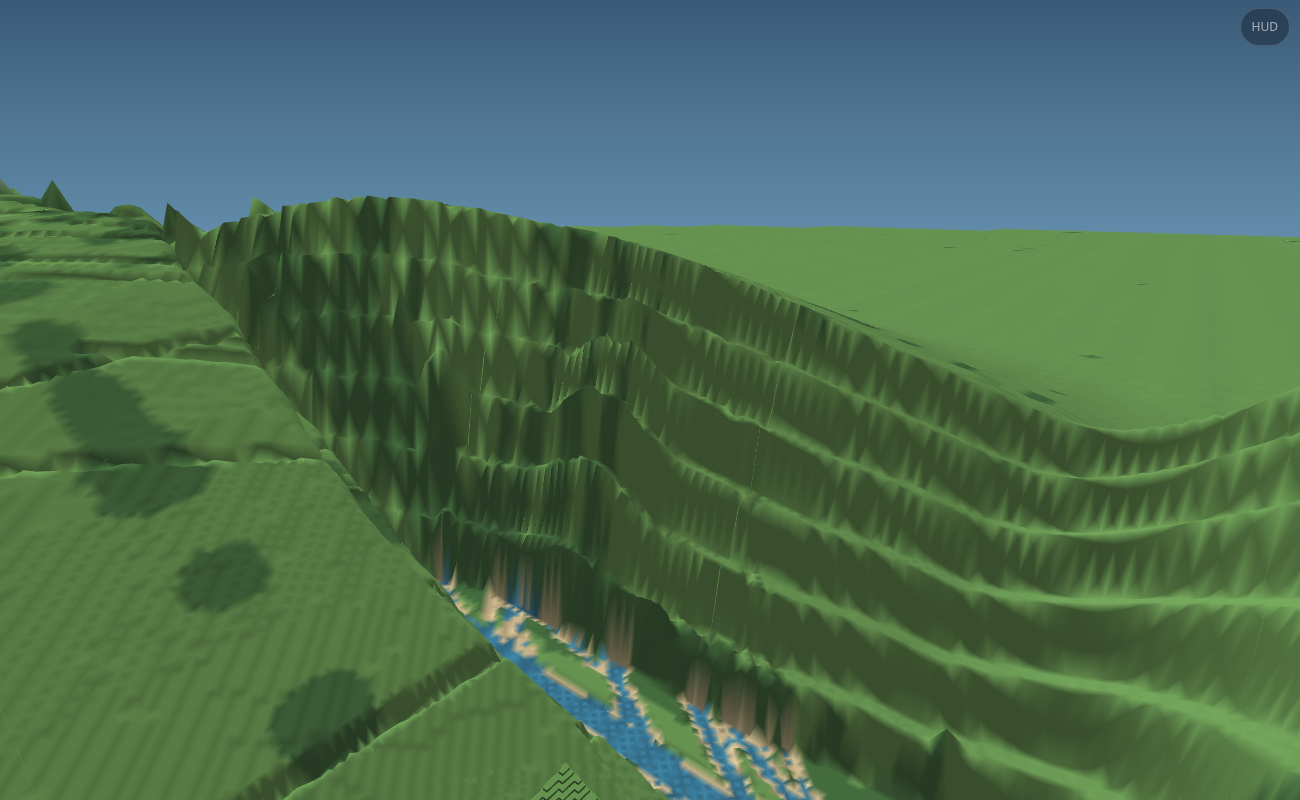
The same spot with terrain=mesh at detail max: the ground as one mesh on the ruler, 611 tiles of 256 cells and 345,402 triangles, five and a half times fewer. Every cell is a corner within 96 of the camera, every other within 192, every fourth within 384, and so on out; no crack between any two tiles. The trade: on the gorge's sheer walls, 4 to 16 cells between corners draw a comb of teeth where ultra's samples keep the terraces clean.
▶ Go there mesh-2-gorge-mesh
The same spot with terrain=mesh at detail max: the ground as one mesh on the ruler, 611 tiles of 256 cells and 345,402 triangles, five and a half times fewer. Every cell is a corner within 96 of the camera, every other within 192, every fourth within 384, and so on out; no crack between any two tiles. The trade: on the gorge's sheer walls, 4 to 16 cells between corners draw a comb of teeth where ultra's samples keep the terraces clean.
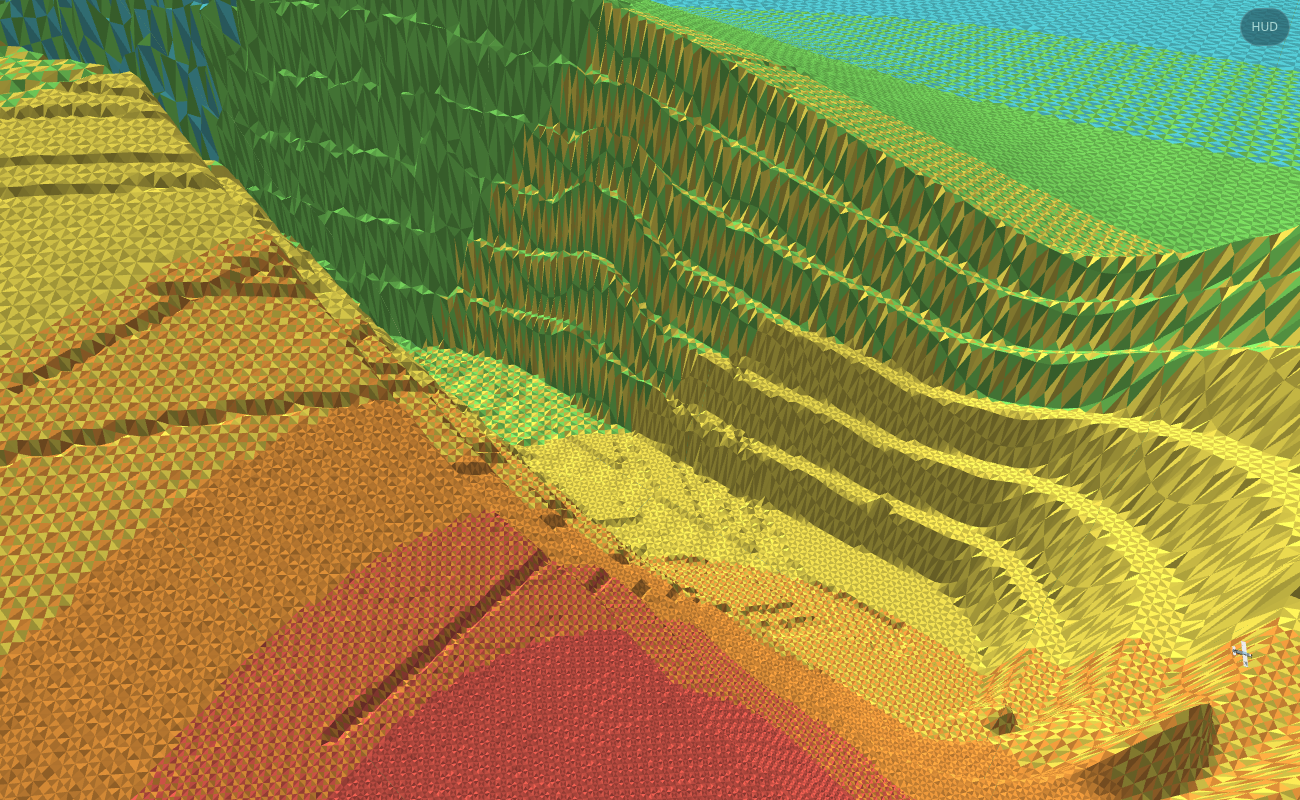
The ruler's rings, triangle by triangle (meshlevels=1): red triangles are one cell a leg, orange two, yellow four, green eight, cyan sixteen. A corner's level is its Gaussian rank, whose half is the ruler's min(v2 x, v2 z), and a level is kept within K times 2 to the half-level of the camera, so each colour is a ring twice the width of the last.
▶ Go there mesh-3-gorge-levels
The ruler's rings, triangle by triangle (meshlevels=1): red triangles are one cell a leg, orange two, yellow four, green eight, cyan sixteen. A corner's level is its Gaussian rank, whose half is the ruler's min(v2 x, v2 z), and a level is kept within K times 2 to the half-level of the camera, so each colour is a ring twice the width of the last.
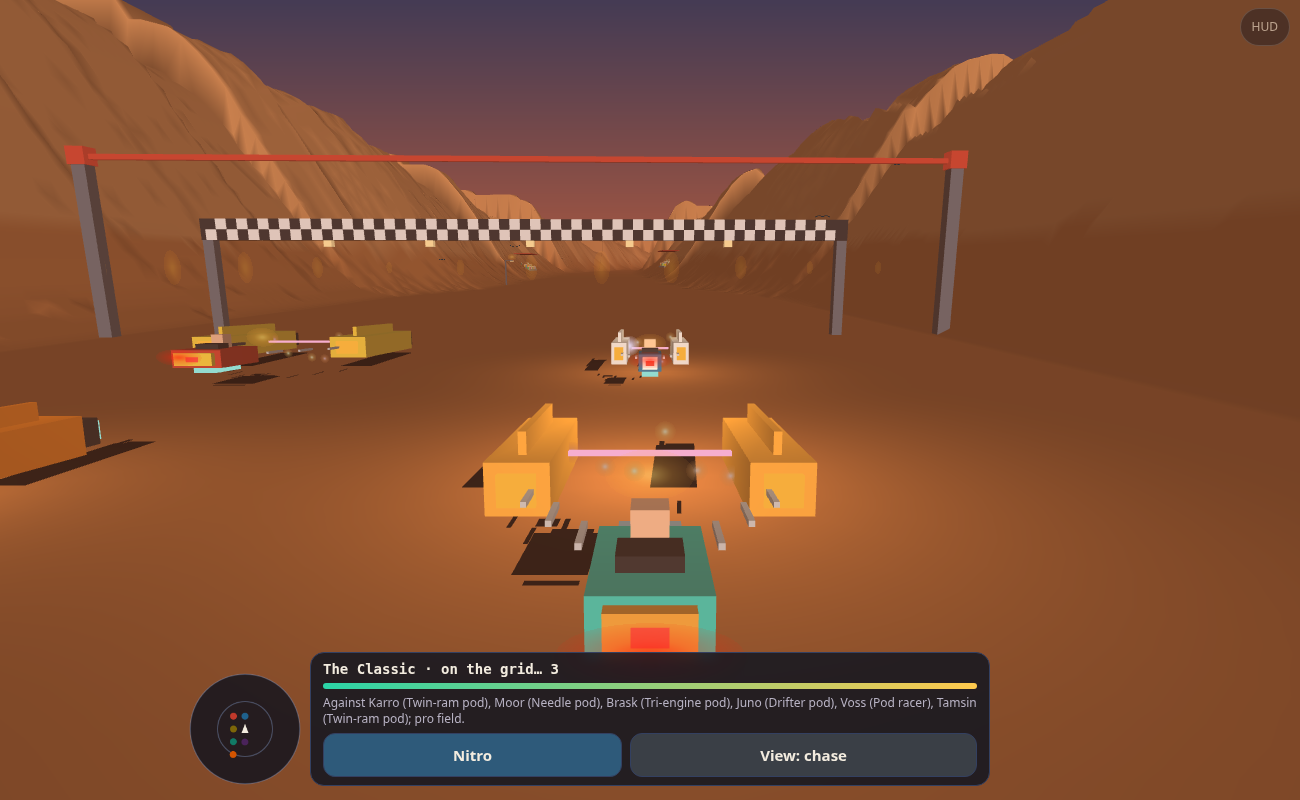
The Emberline's grid with terrain=mesh: a pod course has no trees and no roads, so no voxel chunk is drawn at all and the mesh runs to the pods' feet (405,376 triangles out to the horizon). At a pod's x3 pace round the lap the mesh kept up with 67 to 121 hole-seconds in ten seconds where ultra had 444 to 1,080 (two runs each, in a headless browser drawing in software).
▶ Go there mesh-4-emberline-grid
The Emberline's grid with terrain=mesh: a pod course has no trees and no roads, so no voxel chunk is drawn at all and the mesh runs to the pods' feet (405,376 triangles out to the horizon). At a pod's x3 pace round the lap the mesh kept up with 67 to 121 hole-seconds in ten seconds where ultra had 444 to 1,080 (two runs each, in a headless browser drawing in software).
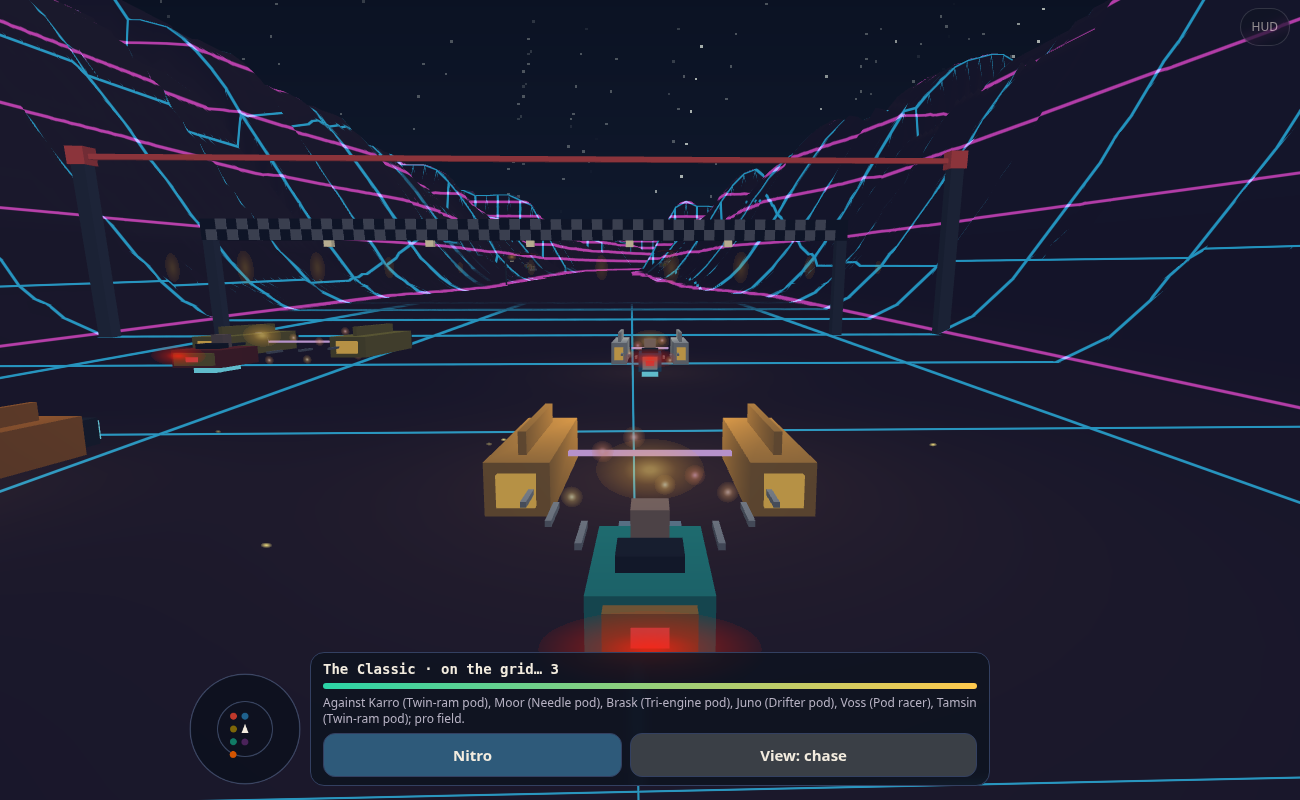
The same grid at night with far=neon: every look draws the mesh, the ground under the pods too, so the cyan grid and the pink height lines run from the start line to the canyon's rim.
▶ Go there mesh-5-emberline-neon
The same grid at night with far=neon: every look draws the mesh, the ground under the pods too, so the cyan grid and the pink height lines run from the start line to the canyon's rim.