Land from the library: the light cone, ziggurats, rivers and the max law

What the rest of pytoolz held for the ranges: the prefix law read as stone, nested plateaus from distance_to, a river basin per region from the run law, and the max-with-relief combine of the original RangeBlends terrain. All four in both twins, checked against one fixture, written up in LAND_FROM_THE_LIBRARY.md.

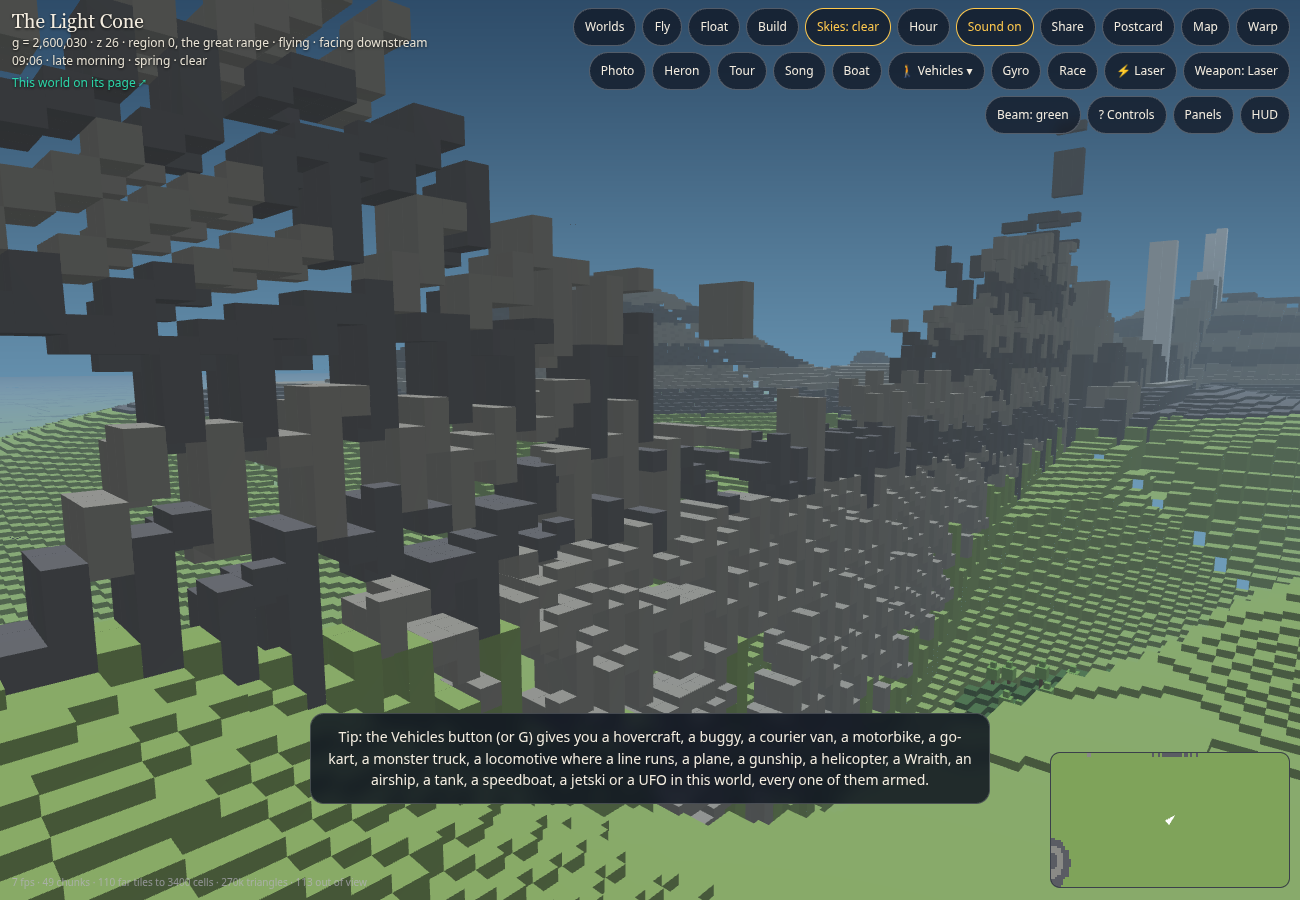
The Light Cone from the air: rule 30's light-cone edge read as stone. One generation per cell along the wall, every column solid up to its run (CUM[v2(g+1)] bits, the same ladder the hills use) and above it the exact bits of the edge as a lace of overhangs and pockets, two blocks a bit. Nothing is simulated per cell: bit y is periodic with period 2^p(y), so one stored period per depth answers every generation, in Python and in the browser alike.
▶ Go there lib-1-the-light-cone-from-the-air
The Light Cone from the air: rule 30's light-cone edge read as stone. One generation per cell along the wall, every column solid up to its run (CUM[v2(g+1)] bits, the same ladder the hills use) and above it the exact bits of the edge as a lace of overhangs and pockets, two blocks a bit. Nothing is simulated per cell: bit y is periodic with period 2^p(y), so one stored period per depth answers every generation, in Python and in the browser alike.
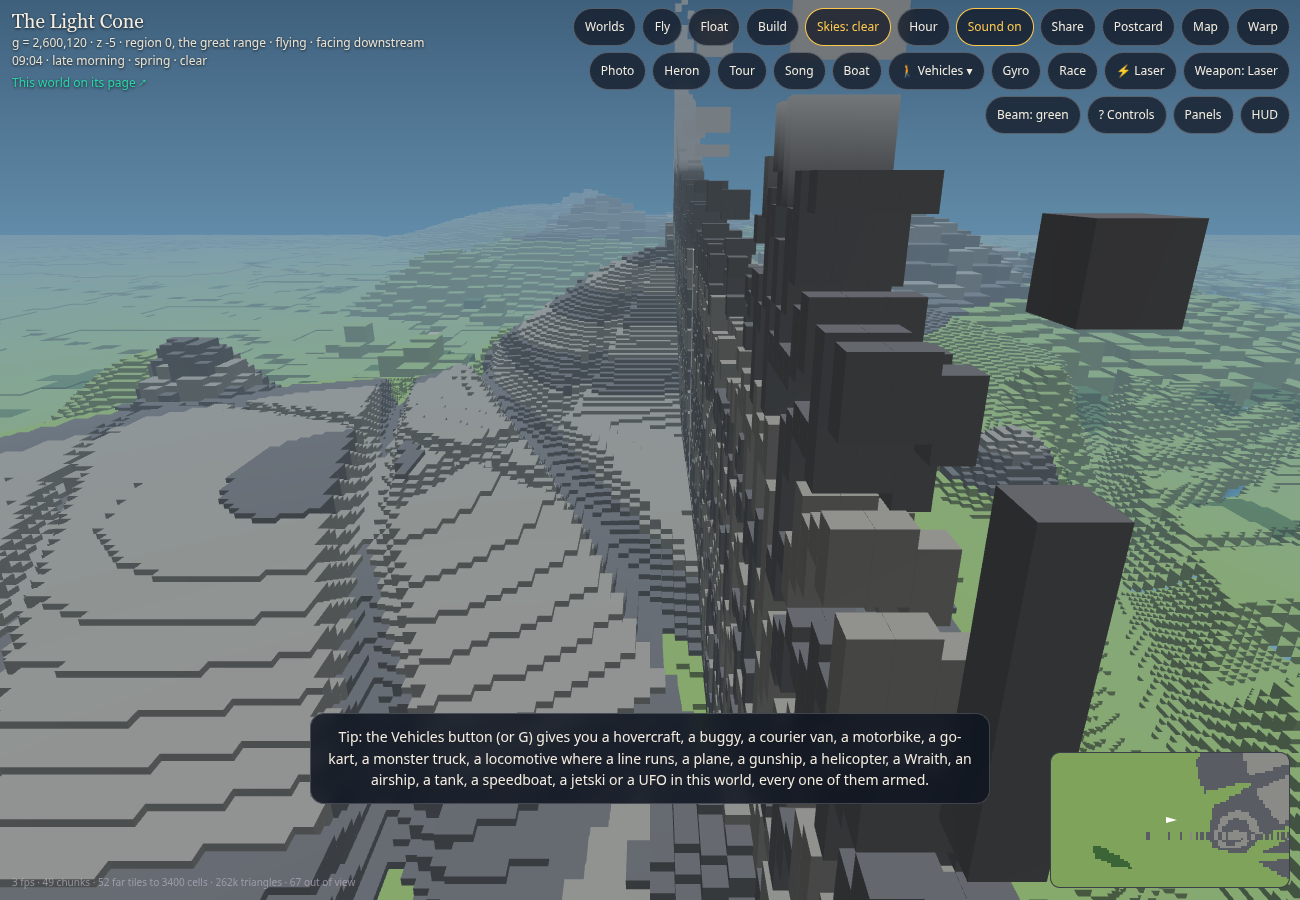
Along the wall, looking east with the hills on the left. The lace repeats fast low down (periods 2, 4, 8) and slowly higher up (4096 and more), so the strata change with altitude; a rank-12 column runs 34 deep and shows only the eight bits of lace the verified spectrum still reaches. The wall rides the Ruler Hills and the rivers cut under it.
▶ Go there lib-2-along-the-light-cone
Along the wall, looking east with the hills on the left. The lace repeats fast low down (periods 2, 4, 8) and slowly higher up (4096 and more), so the strata change with altitude; a rank-12 column runs 34 deep and shows only the eight bits of lace the verified spectrum still reaches. The wall rides the Ruler Hills and the rivers cut under it.
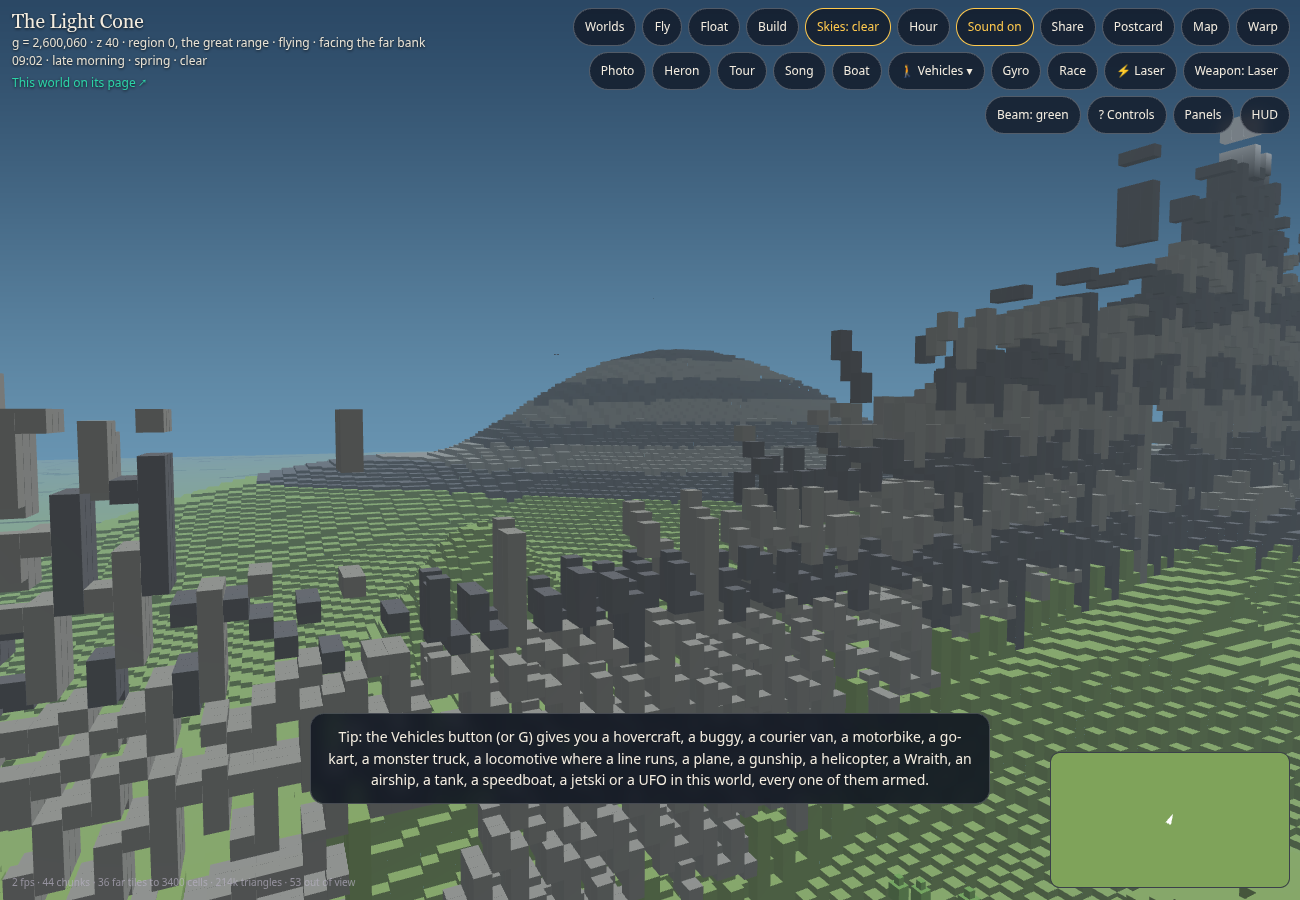
The wall from the plain, a rank-6 hill behind. Three walls run the length of the range at z = 0 and z = ±240, each at its own phase of the edge, so they never repeat each other. The engine keeps the lace as spans per cell and draws them as boxes with bottoms; WanderCity.spansAt reads them and the smoke test checks them against coneSpans.
▶ Go there lib-3-the-light-cone-wall-on-the-plain
The wall from the plain, a rank-6 hill behind. Three walls run the length of the range at z = 0 and z = ±240, each at its own phase of the edge, so they never repeat each other. The engine keeps the lace as spans per cell and draws them as boxes with bottoms; WanderCity.spansAt reads them and the smoke test checks them against coneSpans.
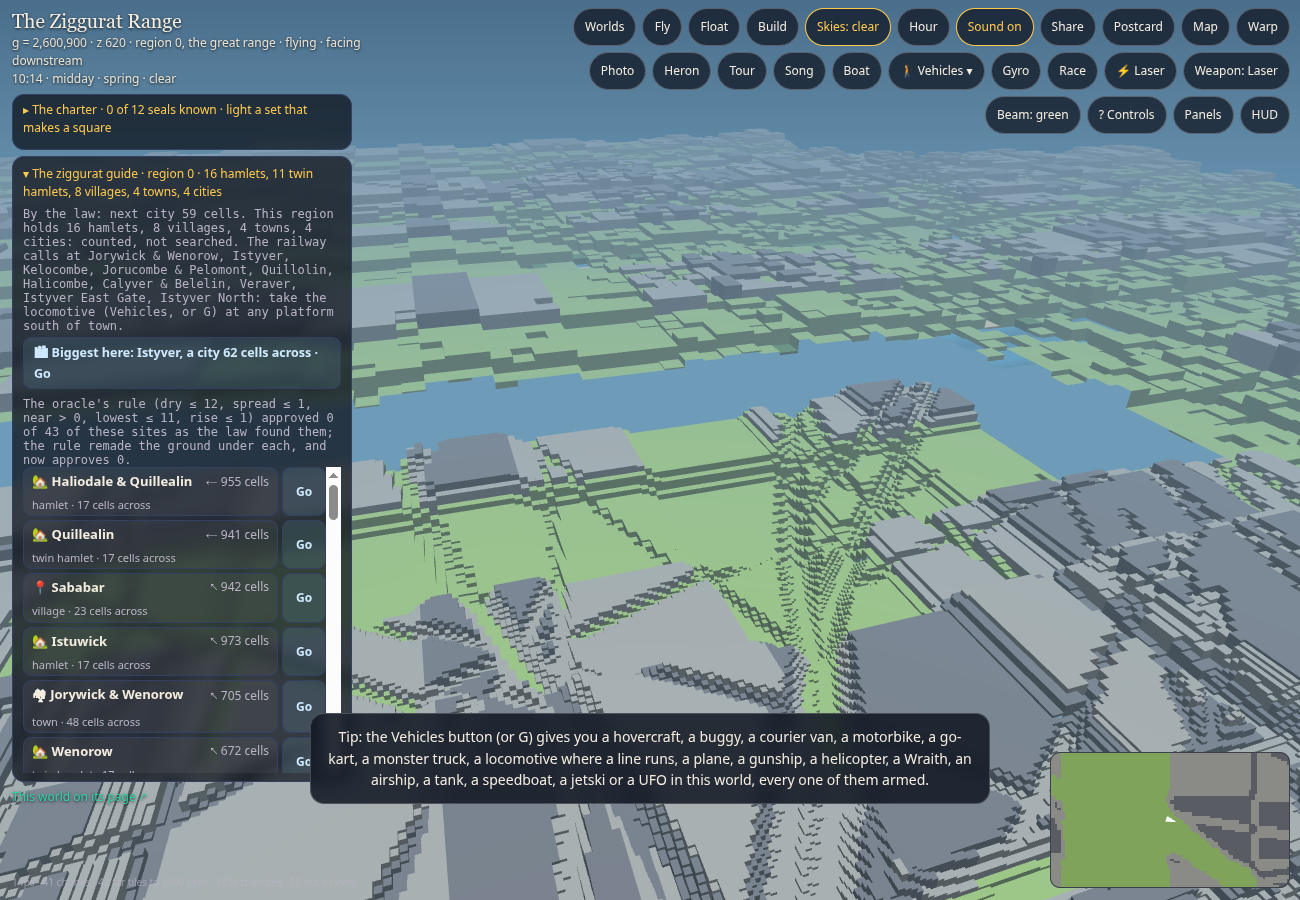
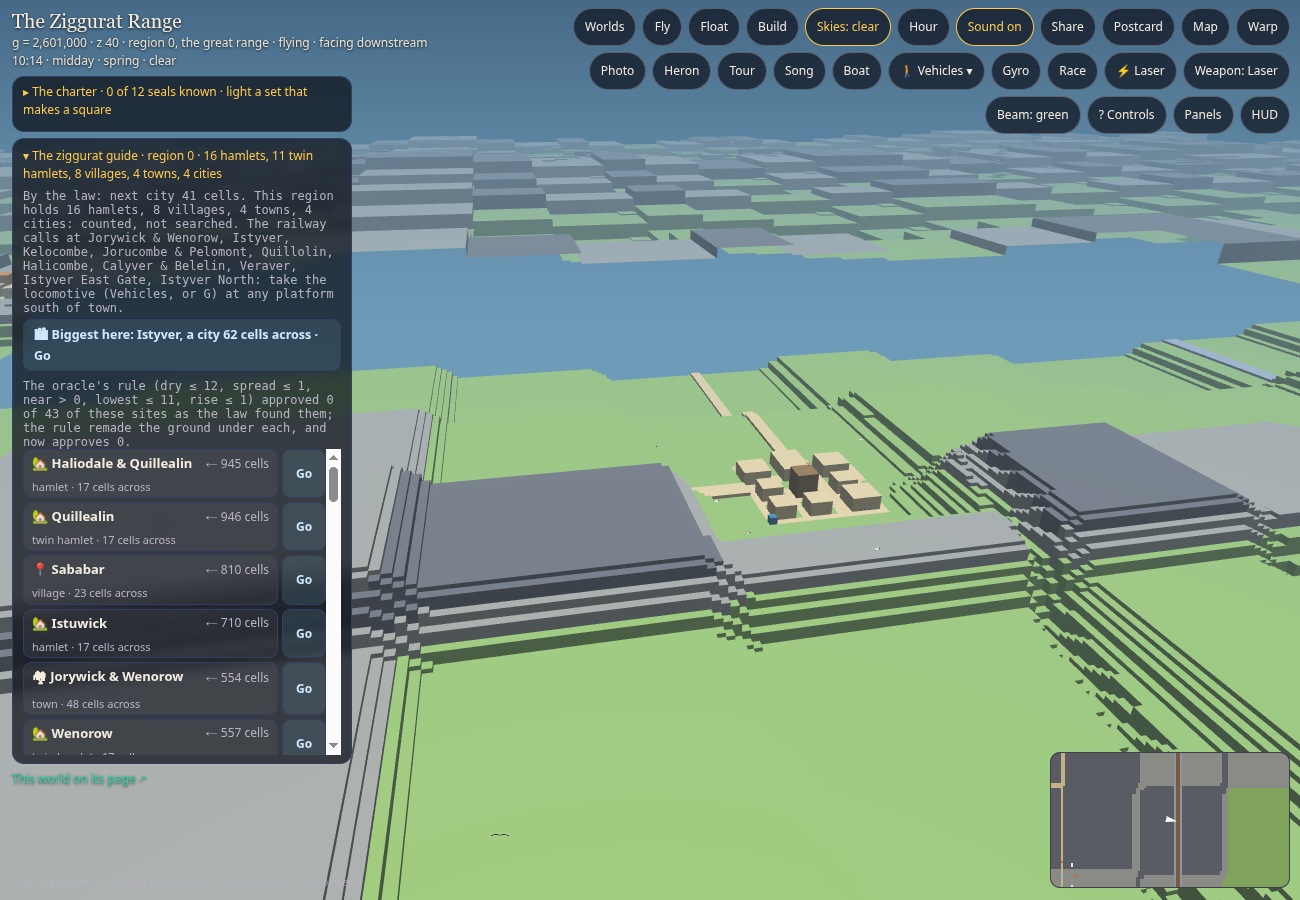
The Ziggurat Range: nested plateaus from distance_to. Every rank from seven up owns a band a quarter of its spacing wide either side of its columns, the ground steps twelve blocks for every band a cell stands in, and every band edge is a six-cell ramp, so a rank-9 column is a stack of flats each wider than the one above. The dark dendritic cuts are the region's river basin pressed into the plateaus: Strahler order is a ruler sequence, and Horton's ratio comes out near 3 untuned.
▶ Go there lib-4-ziggurats-from-the-air
The Ziggurat Range: nested plateaus from distance_to. Every rank from seven up owns a band a quarter of its spacing wide either side of its columns, the ground steps twelve blocks for every band a cell stands in, and every band edge is a six-cell ramp, so a rank-9 column is a stack of flats each wider than the one above. The dark dendritic cuts are the region's river basin pressed into the plateaus: Strahler order is a ruler sequence, and Horton's ratio comes out near 3 untuned.
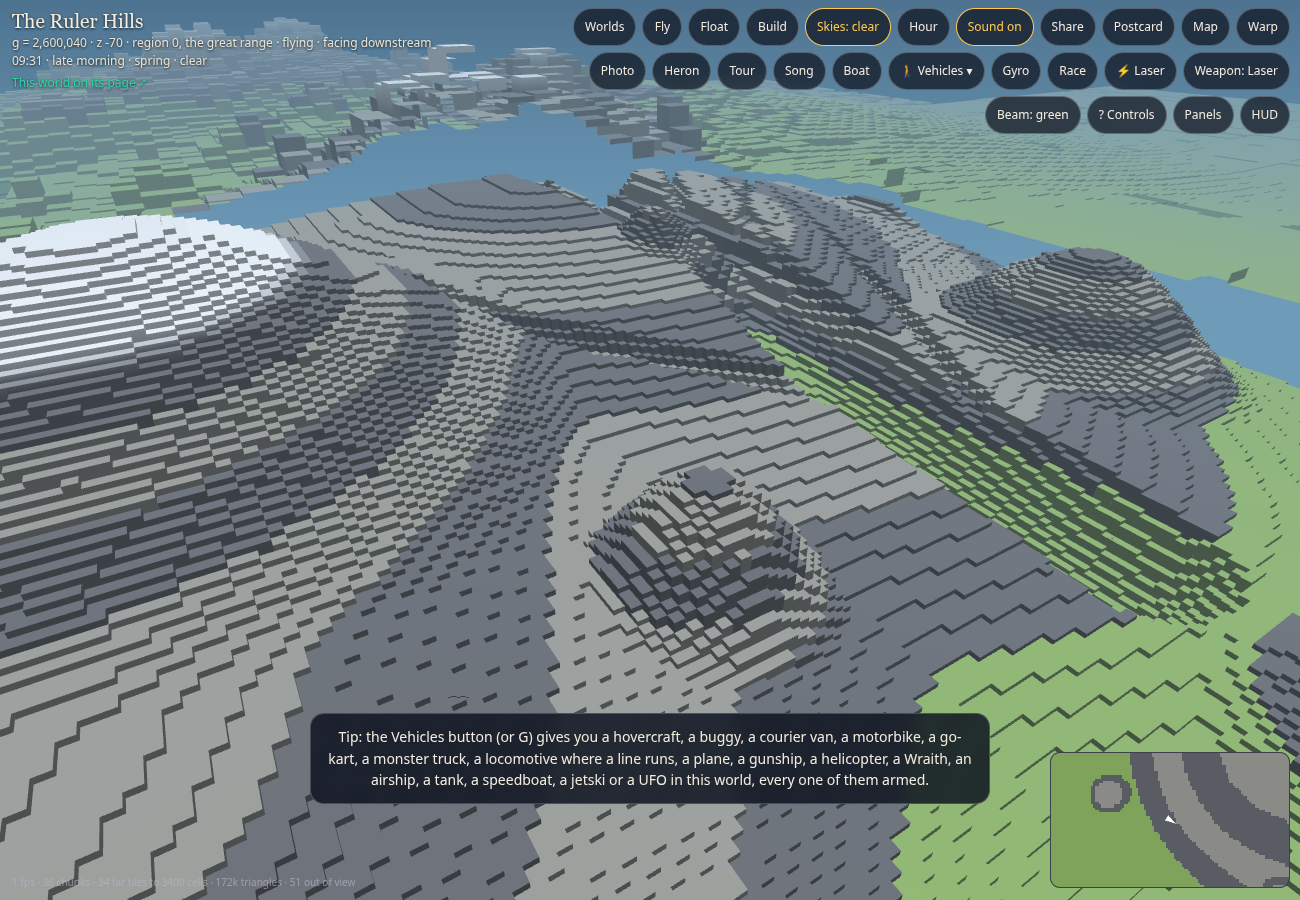
A town on a flat of the Ziggurat Range, the next terrace stepping down behind it. The city law still places towns by column rank; the plateaus put them on ground that was flat before the law terraced it. No flat here is narrower than fifty cells, which was the point: the first Ladder Range gave every other block to the floor and stood the rest up as walls.
▶ Go there lib-5-a-town-on-a-ziggurat
A town on a flat of the Ziggurat Range, the next terrace stepping down behind it. The city law still places towns by column rank; the plateaus put them on ground that was flat before the law terraced it. No flat here is narrower than fifty cells, which was the point: the first Ladder Range gave every other block to the floor and stood the rest up as walls.
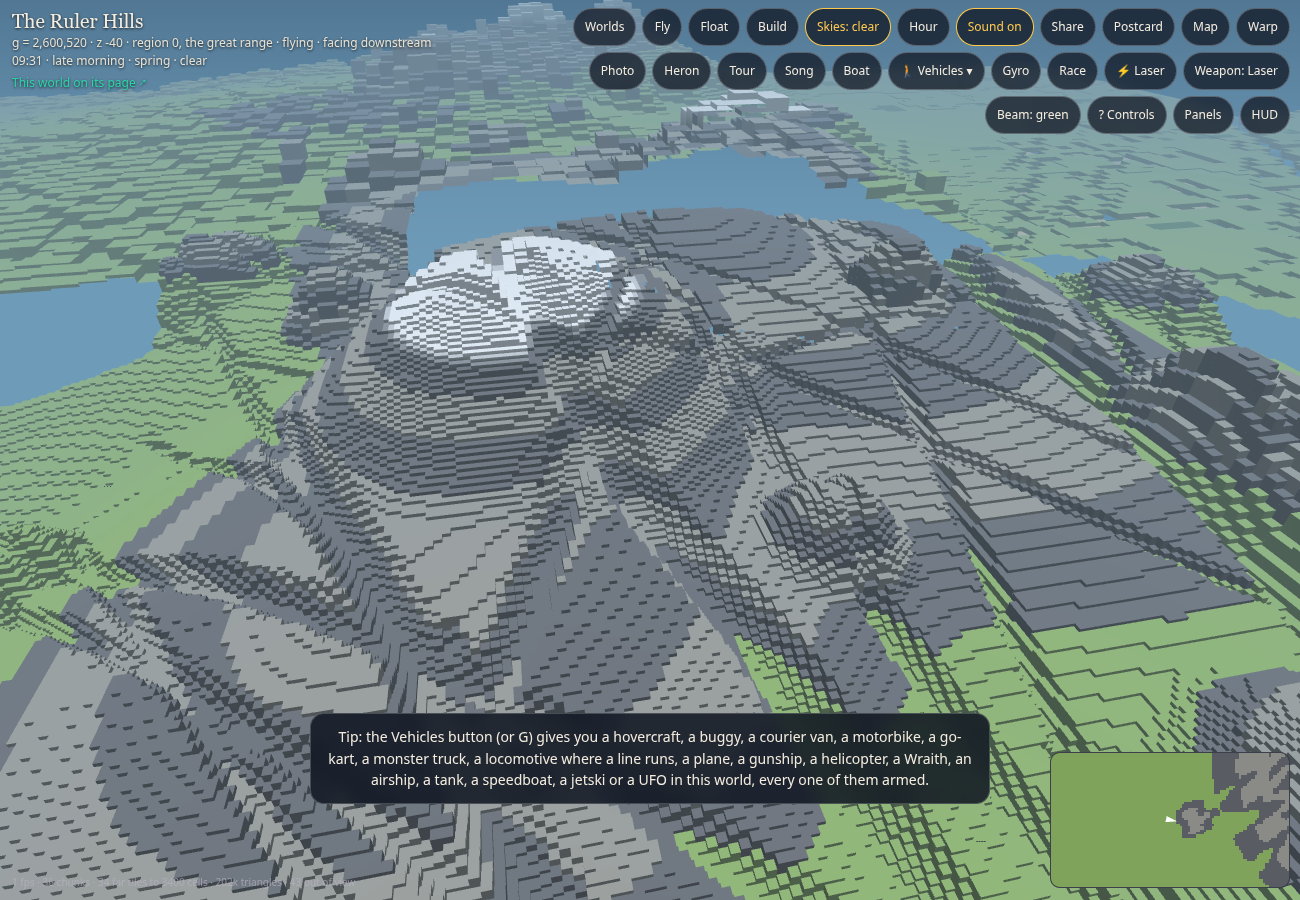
The river of region 0 in the Ruler Hills, near its mouth at the west margin. One basin per region from rangeblends.network, seeded by the indexed hash, laid with its trunk running east; a stream of order o is 1+o cells wide either side and 3+2o blocks deep at its line, so the order-9 trunk drops the plain below the water line and holds water, and where it meets a hill it is a gorge.
▶ Go there lib-6-the-river-mouth-of-the-ruler-hills
The river of region 0 in the Ruler Hills, near its mouth at the west margin. One basin per region from rangeblends.network, seeded by the indexed hash, laid with its trunk running east; a stream of order o is 1+o cells wide either side and 3+2o blocks deep at its line, so the order-9 trunk drops the plain below the water line and holds water, and where it meets a hill it is a gorge.
A tributary cutting round the flank of a rank-9 hill, the trunk in the distance. The cut is the same in both twins: river_cut in Python and riverCut in the browser agree to about two thousandths of a block over 470 sampled cells, the difference being the meander's cosines accumulating over 512 steps.
▶ Go there lib-7-a-river-gorge-through-a-hill
A tributary cutting round the flank of a rank-9 hill, the trunk in the distance. The cut is the same in both twins: river_cut in Python and riverCut in the browser agree to about two thousandths of a block over 470 sampled cells, the difference being the meander's cosines accumulating over 512 steps.
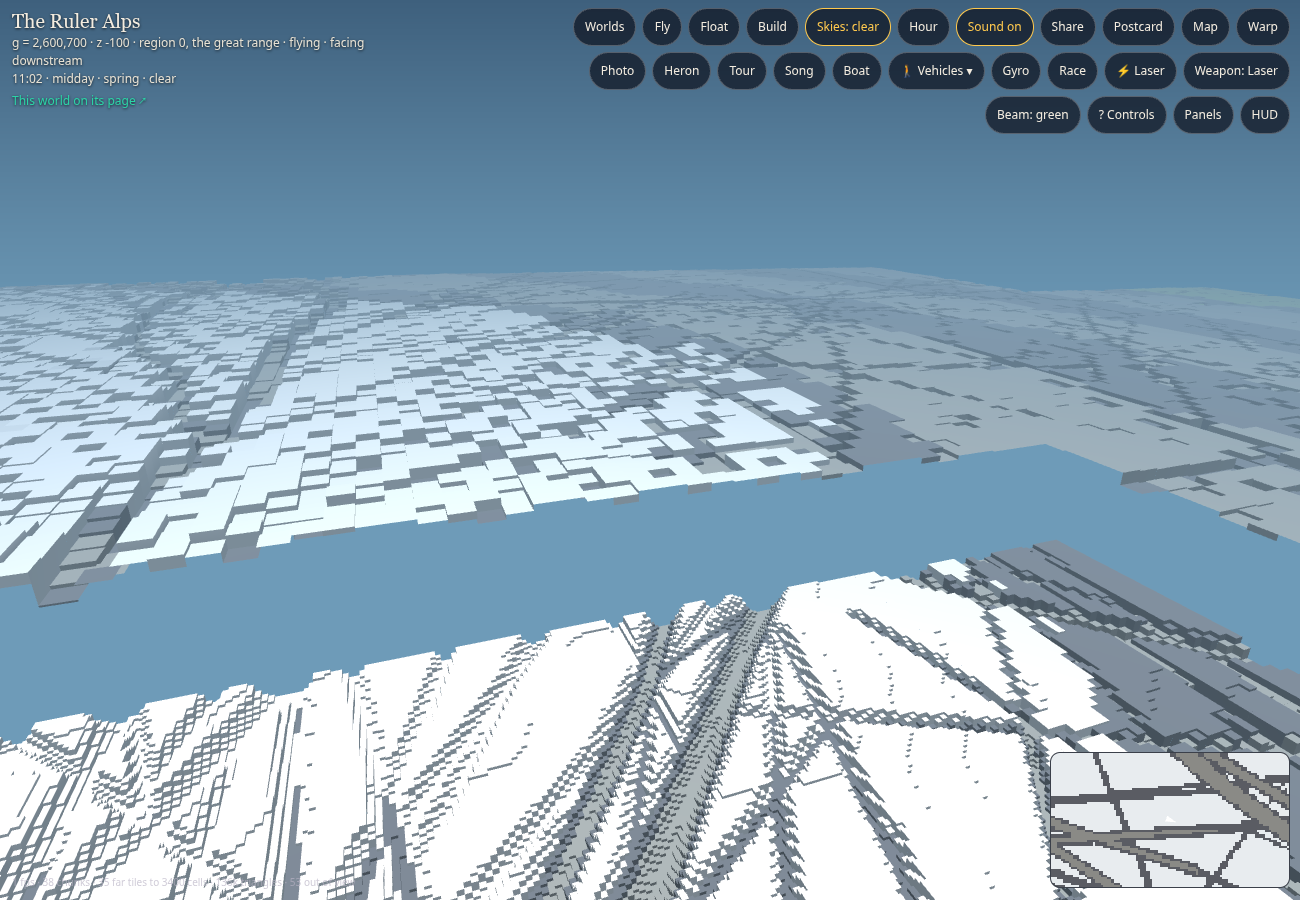
The Ruler Alps under the max law, late morning. Instead of summing every hill that reaches a cell, the tallest wins, the way rangeblends.ridge always did, and the relief term sinks the flats against the tallest possible hill. At the law's own radius the ranks six to eleven stand as high massifs, and the rivers cut gorges through them. A knob on both twins; the summed worlds are unchanged.
▶ Go there lib-8-the-alps-by-the-max-law
The Ruler Alps under the max law, late morning. Instead of summing every hill that reaches a cell, the tallest wins, the way rangeblends.ridge always did, and the relief term sinks the flats against the tallest possible hill. At the law's own radius the ranks six to eleven stand as high massifs, and the rivers cut gorges through them. A knob on both twins; the summed worlds are unchanged.
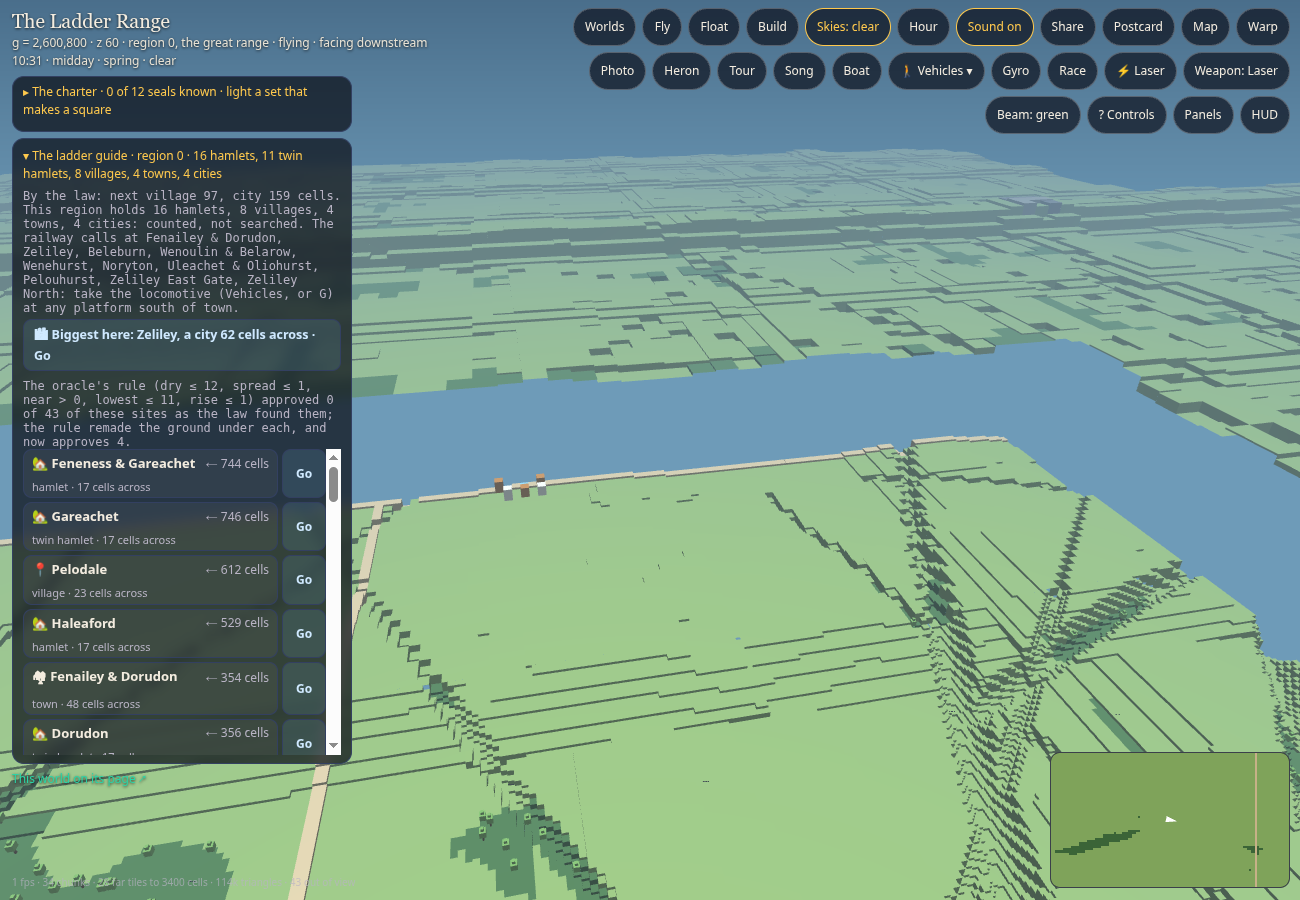
The Ladder Range with its new knobs: step 48, ramp 16, scale 0.6. The old law is untouched (the fixture still checks it at step 8), but the world's blocks are six times wider, the ramps five times longer, and a buggy climbs the whole staircase. A lake fills a river cut in the plateau.
▶ Go there lib-9-the-ladder-range-with-48-cell-plateaus
The Ladder Range with its new knobs: step 48, ramp 16, scale 0.6. The old law is untouched (the fixture still checks it at step 8), but the world's blocks are six times wider, the ramps five times longer, and a buggy climbs the whole staircase. A lake fills a river cut in the plateau.